
Introduction
The International Conference on Population Development (ICPD) is a revolutionary global conference held in Cairo in 1994 which saw the adoption of the Programme of Action (PoA) by 170 countries that contributed to women’s reproductive health and rights in the international arena. While ambitious, ICPD PoA is crucial to deliver equitable, inclusive and sustainable development as it asserts SRH as a crucial agenda for empowerment of girls and women across the globe. However, the rise of opposition, extremist groups, conservative and populist governments, cuts in funding and efforts to undermine the global consensus around SRHR have imperilled the achievement of the PoA. [i]
The year 2019 marks the 25th year since ICPD was convened. The Nairobi Summit, organized from 12-14 November, aimed to mobilize political will and financial commitment for the urgent and full implementation of the ICPD PoA. It centered on building global consensus for zero preventable maternal deaths, zero unmet need of family planning, zero sexual and gender based violence and harmful practices against women and girls. The summit brought together heads of states, political leaders, community leaders, activists, health care providers, technical experts, indigenous people, young people, people living with disabilities, people from diverse sexual and gender minorities, civil society organizations, private organizations, academics and advocates of Sexual and Reproductive Health and Rights (SRHR).
Even today, 800 adolescents, girls and women die due to preventable birth related death, 214 million women are denied access to contraception, and 25 million women undergo unsafe abortion across the globe.[ii] The World Health Organization reports that 12 million adolescent girls aged 15-19 give birth every year and an estimated 3.9 million girls aged 15–19 undergo unsafe abortion - mostly in low- and middle-income countries These complications from pregnancy and childbirth are a leading cause of death among girls aged 15–19 years in low and middle income countries.[iii] If we take WHO data from 2017, 214 million women of reproductive age in developing regions have unmet need of family planning. [iv]
Where does Nepal stand?
Nepal is one of the 179 countries that adopted the ICPD PoA in 1994. The 2016 Nepal Demographic Health Survey (NDHS) shows a quite remarkable progress in nutrition, maternal health and child health; however the indicators related to sexual and reproductive health (SRH) have not declined accordingly. In 2016, 17% of women aged 15-19 had begun childbearing. If fertility were to remain constant at current levels, a woman from Nepal would bear an average of 2.3 children in her lifetime, compared to a fertility rate of 4.1 children reported in the 2001 NDHS. Fertility is still higher amongst rural women than among urban women. The current median age of first marriage was 17.9 in 2016 as compared to 16.8 years for women in 2001. In regards to contraception, in 2016 53% of married women used a method of family planning compared to 39% in 2001. Currently, 43% are using a modern method and 10% using a traditional method.[v] And there has been a slight decline in the unmet need for family planning from 28% in 2001, to 24% in 2016.
NDHS 2016 shows that only 21% of young women and 27% of young men have comprehensive knowledge of HIV prevention. Among men who had two or more sexual partners in the 12 months prior to the survey, 40% reported using a condom during last sexual intercourse while 60% did not use condom, which increases the risk of sexually transmitted infections. NDHS 2016 reports that 22% of women in Nepal age 15-49 have experienced physical violence since the age of 15, and 7% have experienced sexual violence. 6% of women who have been pregnant have experienced violence during pregnancy. This has an impact on the mental health of an individual as well. Negative consequences related to SRHR violations include depression and anxiety.[vi] The Gender Inequality Index (2015) shows that Nepal ranks at 115th globally while the Gender Development Indicator (GDI) shows a low human development ranking position of 145 , with lowest GDI among all South Asian countries.[vii]
Nepal has made a significant progress since 1994 to promote and ensure access to SRHR for young people . Legalization of Safe Abortion, Adolescent Sexual Health and Rights Strategy, free safe abortion services, adolescent friendly health services, progressive sexuality education for in-school curriculum are some of the key achievements in policies to implement the ICPD Program of Action. The Safe Motherhood and Reproductive Health Act 2018 is one of the milestone achievements for civil society, it recognizes women’s reproductive rights including safe abortion.
Despite the efforts of the government to introduce progressive policies and acts, shortcomings in program design and implementation have been observed. Limited resource allocation and budget constraints have led to inadequate infrastructure, equipment, well-trained service providers and mechanisms of quality assurance. This has hindered both access to information and services regarding SRHR, as is clearly evidenced in many different reports by government and civil society.
What happened in Nairobi this year?
The Nairobi Summit this year was focused to accelerate the ICPD Program of Action and reaffirm to those commitments. Over 9,500 delegates from more than 170 countries took part in this radically inclusive conference, uniting behind the Nairobi Statement, which establishes a shared agenda to complete the ICPD Program of Action.[viii] By the end of the Summit, billions of dollars were pledged by public and private sectors to achieve the transformative goals by 2030. While some might argue that process of Nairobi Summit was not an inter-governmental process with negotiations and consensus and therefore the outcome document and commitments are not normative or mandatory. But, the idea of Nairobi Summit was to re-energize and re-align the efforts of governments and non-government agencies with an already well negotiated ICPD Program of Action in 1994. Most importantly, it is clear that the SRHR of women and girls are not up for negotiation. During the closing remarks, Natalia Kanem, Executive Director of UNFPA, mentioned the formation of a high-level commission to follow up on the commitments made during the Summit through national periodic progress reports on those commitments.
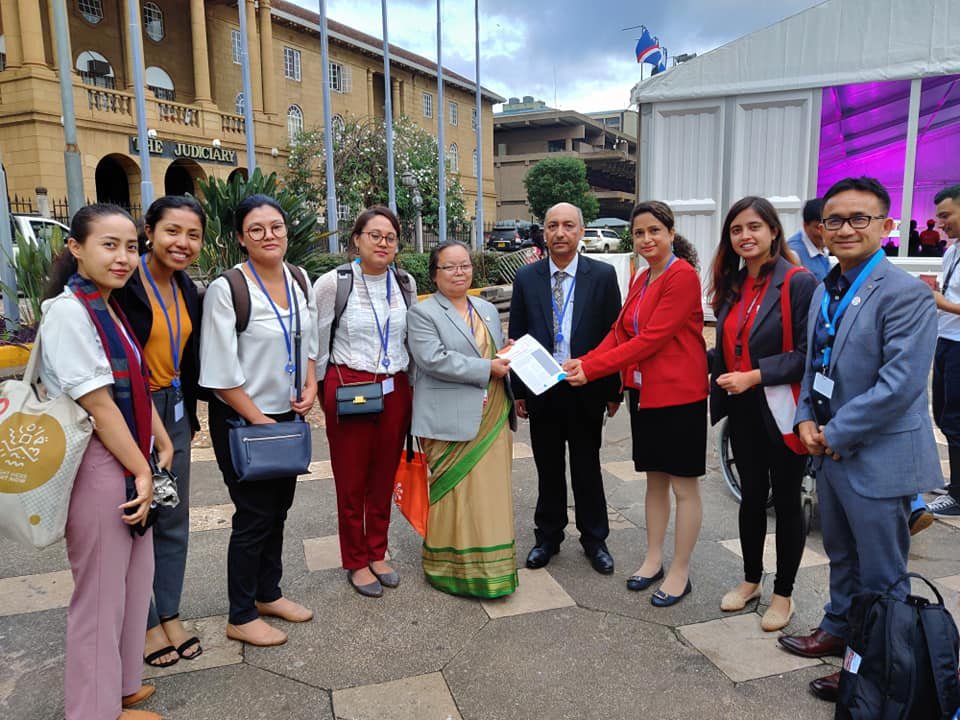
The Government of Nepal presented a very progressive national commitment at the Summit. The high-level government delegation was led by the then Minister of Women, Children and Senior Citizens, Ms. Tham Maya Thapa. The commitment explicitly mentions that the Constitution of Nepal ensures the rights of gender and sexual minorities. Among the four commitments, investing in young people’s well-being through up scaling of adolescent friendly health services and comprehensive sexuality education (CSE) is truly commendable. Prior to the Summit, Right Here Right Now Nepal with APA Member YUWA, along with UNFPA and Y-PEER developed and handed-over the Youth Recommendations on National Commitment to the Head of Delegations which was incorporated in the national commitment. The Youth Recommendations were developed through National Youth Consultation 2019 where young people from different marginalized communities and provinces were involved. Many civil society organizations working for youth, women, LGBTIQ and other vulnerable groups coordinated and lobbied to include languages addressing issues of safe abortion, diverse sexual and gender identities, CSE and other intersectionalities in the national commitment.
Moving forward
It is urgent for the government to come up with a concrete action plan to implement the Nairobi commitments as we head to a decade of action to fulfill some bold commitment made by ICPD. Government must ensure accessible, affordable and sustainable information and services related to sexual and reproductive health. Strategies to implement the Adolescent Friendly Health Service (AFHS) need to be revised and strengthened for effective utilization of AFHS among young people. The government must take firm action to ensure stigma-free and youth-friendly, safe abortion services, marriage equality and to reduce gender-based violence in Nepal. Partnership with non-government agencies and the private sector is crucial and the engagement of young people is important in the process of designing, implementing, monitoring and evaluating a course of action
The current approach which makes Environment, Health and Population (EHP) an alternative subject in grade 9 and 10 restricts adolescent’s rights to information regarding sexuality education in our society and context. Thus, it is equally important to make the EHP subject compulsory for all in-school adolescents and allocate resources for teachers’ training on CSE. Freedom of expression must be ensured and the state’s control over the sexuality of young people in the name of culture and tradition must be stopped. The government must promote programs and partner with civil society organizations and the private sector to provide factual and complete information on SRHR. Lastly, the Government of Nepal must acknowledge and adopt a liberal approach towards advocacy efforts of civil society and not shrink the space at any level if we are to achieve the commitment made at the ICPD25 and beyond.
Author Information:
Amit Timilsina is a member of the Asia Pacific Alliance, board of director at Youth Coalition for Sexual and Reproductive Rights and Women Deliver Young Leader 2018.
Sanskriti Shrestha is PMEL Officer for Right Here Right Now-Nepal, YUWA. YUWA is a member organization of Asia Pacific Alliance.
Photo:
Youth delegates handing over youth recommendation for national commitment at Nairobi Summit. Photo Credit: Visible Impact
[i] International Planned Parenthood Federation. World Population Day and ICPD: How far have we come? July 2019.
[ii] World Health Organization. Evidence brief: contraception. 2019. Available from: https://apps.who.int/iris/bitstream/handle/10665/329884/WHO-RHR-19.18-eng.pdf?ua=1
[iii] World Health Organization. Evidence brief: adolescent pregnancy. 2019. Available from:
https://apps.who.int/iris/bitstream/handle/10665/329883/WHO-RHR-19.15-eng.pdf?ua=1
[iv] World Health Organization. Evidence brief: contraception. 2019. Available from: https://apps.who.int/iris/bitstream/handle/10665/329884/WHO-RHR-19.18-eng.pdf?ua=1
[v] Ministry of Health, Nepal; New ERA; and ICF. Nepal Demographic and Health Survey 2016. Kathmandu, Nepal: Ministry of Health, Nepal. 2017. Available from: https://www.dhsprogram.com/pubs/pdf/fr336/fr336.pdf
And Ministry of Health, Nepal; New ERA; and ICF. Nepal Demographic and Health Survey 2001. Kathmandu, Nepal: Ministry of Health, Nepal. 2002. Available from: https://dhsprogram.com/pubs/pdf/fr132/fr132.pdf
[vi] ibid
[vii] National Alliance of Women Human Rights Defenders, Nepal. CEDAW shadow report. September 2018. Available from:
https://tbinternet.ohchr.org/Treaties/CEDAW/Shared%20Documents/NPL/INT_CEDAW_CSS_NPL_32584_E.pdf
[viii] UNFPA. Press release: Nairobi Summit on ICPD25 ends with a clear path forward to transform the world for women and girls. November 2019.
Available from: https://www.unfpa.org/press/nairobi-summit-icpd25-ends-clear-path-forward-transform-world-women-and-girls