
ASIA PACIFIC CSO VOICES AT UN ESCAP
The Asia-Pacific Preparatory Meeting for the 70th Session of the Commission on the Status of Women (CSW70) took place on 29 -30 January at the United Nations Conference Centre in Bangkok, Thailand. This year’s CSW70 priority theme is “Ensuring and strengthening access to justice for all women and girls, including by promoting inclusive and equitable legal systems, eliminating discriminatory laws, policies, and practices, and addressing structural barriers.
This gathering serves as a pivotal space for identifying the region’s most pressing challenges in advancing the rights of women and girls to bring forth at the CSW70 this upcoming March.
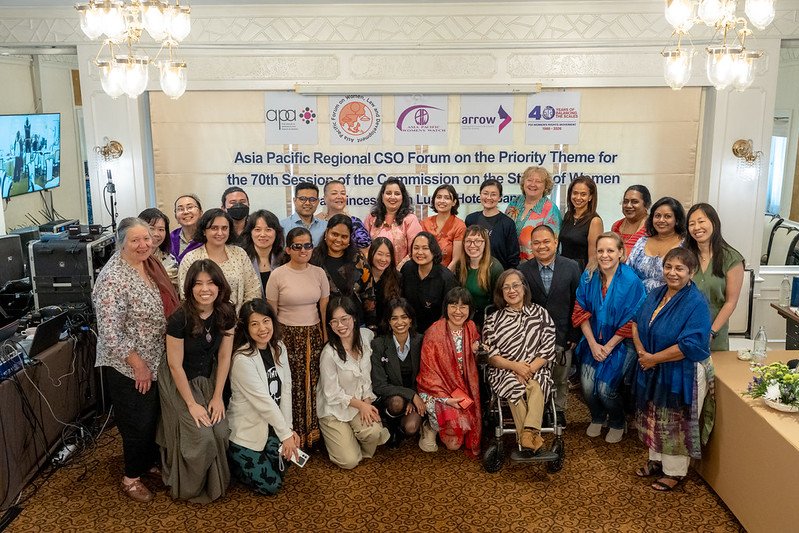
In advance of the intergovernmental Preparatory Meeting, over 100 civil society organizations, feminist activists and grassroots leaders convened for the hybrid Asia-Pacific Regional CSO Forum for the CSW70 from 27–28 January 2026 in Bangkok and online. It was organised by the Civil Society Organisation Steering Committee, Asia Pacific Alliance for Sexual and Reproductive Health and Rights, Asia Pacific Forum on Women and Development, Asia Pacific Women’s Watch, Asia-Pacific Resource & Research Centre for Women and Fiji Women’s Rights Movement, in partnership with UN Women and UN ESCAP. The forum serves as a critical intervention to ensure that regional priorities are not dictated solely by governments but instead shaped by the women and girls facing intersectional barriers to justice. Participants raised their voices to ensure the lived realities of women and girls and the barriers they face to access justices were well reflected.
Across Asia and the Pacific, women and girls face significant obstacles in accessing justice. This is amid global polycrises, rising income inequality, war and conflict, democratic decline, climate change, and uneven digital access. These challenges undermine access to justice and weaken human rights norms and standards.” These strong words opened the Preparatory Meeting, delivered by Noelene Nabulivou, DIVA for Equality, Fiji on behalf of the Asia and Pacific CSO Forum participants , from the collective statement.

During Session 2: Dismantling Discriminatory Laws, Policies and Practices, Uzma Yaqoob from Forum for Dignity Initiatives urged Member States to bridge the widening gap between the existence of legal rights and the reality of accessing them. She stated that despite the existence of normative frameworks such as CEDAW, the Beijing Platform for Action, and the 2030 Agenda for Sustainable Development, women across the region still face profound inequities and violations of their human rights. She highlighted that the regression of sexual and reproductive rights remains a critical barrier to justice.

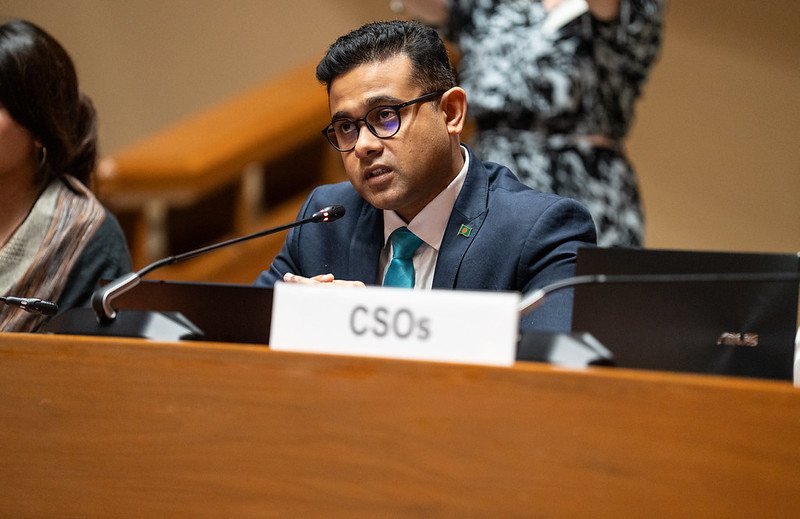
"Discrimination is embedded not only in laws, but in procedures, evidence standards, family laws, digital governance, and institutional responses to violence. Even progressive reforms lose impact when women cannot afford legal support or trust the system to protect them," emphasized SM Shaikat, SERAC Bangladesh, in his statement.
Asia Pacific Regional CSO Forum for the CSW70 O
Over the course of two days, the CSO Forum served as a safe space for strategic discussion and solidarity building. During the forum, participants mapped out the structural barriers impeding access to justice mechanisms for women, girls and people of diverse SOGIESC, including poverty, climate change, migration crises, shrinking civic spaces, violation of bodily autonomy, and regression of sexual and reproductive health and rights among others.
The CSO forum convened at a critical juncture of growing concerns regarding the systematic exclusion of civil society. Limited resources, restrictive environments and travel bans frequently constrain the advocacy efforts of civil society members within the CSW and other intergovernmental spaces. We call for governments to ensure human rights defenders have meaningful access within these systems and to remove barriers of access across all UN processes.
We remain committed to monitoring government follow-through on their international commitments while actively resisting exclusionary practices that push out civil society from contributing to normative framework and intergovernmental processes. The culmination of these dialogues was the consolidation of the collective Asia Pacific CSO Statement for CSW70, find it here.